Central Florida Real Estate Market Report – September 2026
Market Overview
Steady Home Prices, Slower Sales, and More Choices for Buyers
By Yellow Mountain Realty
Central Florida’s residential market moved further toward balance in September 2026. The median Orlando-area sale price remained close to $400,000, but completed transactions slowed and available inventory increased. Buyers gained more time to compare homes, while sellers faced greater pressure to price realistically and present their properties well.
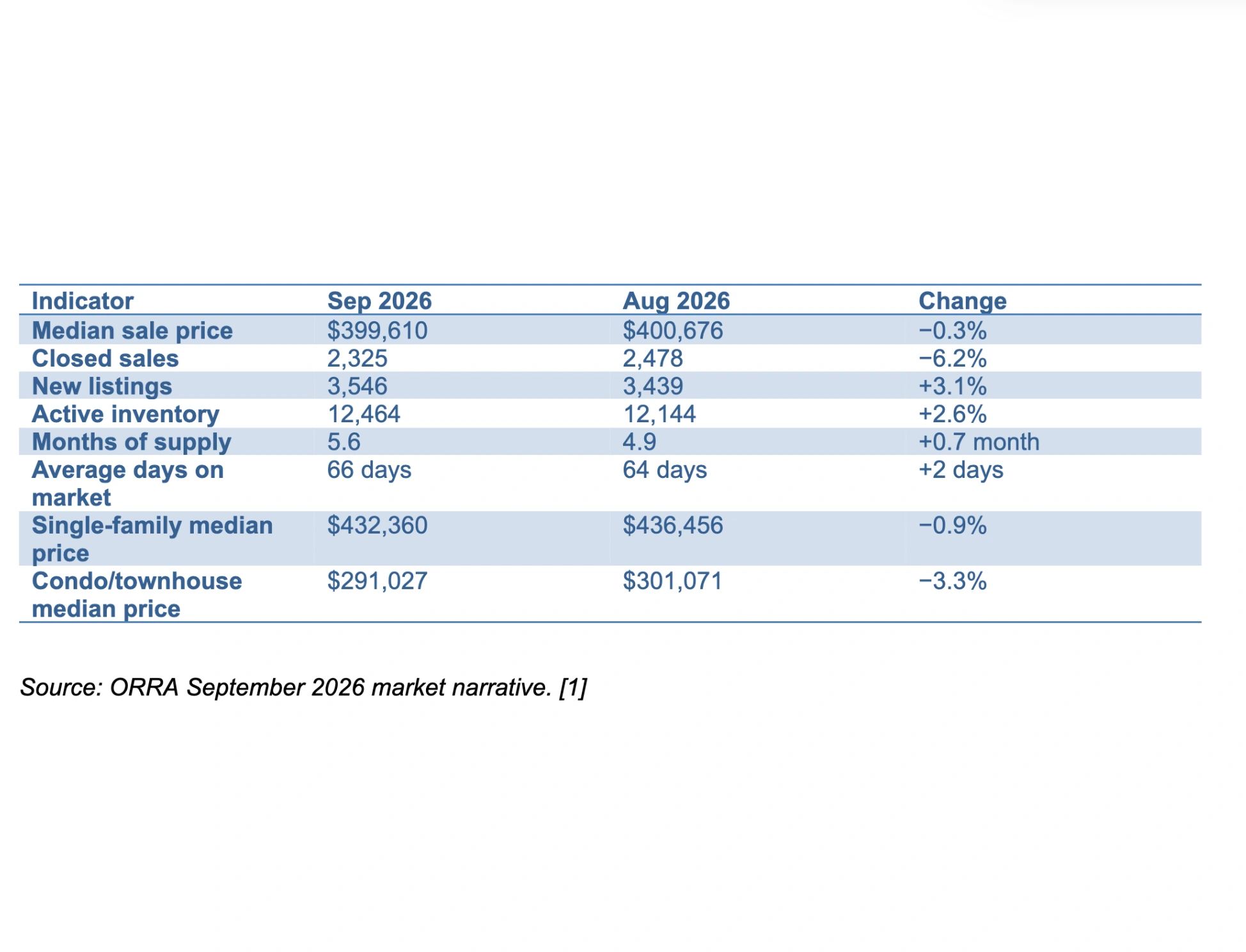
According to the Orlando Regional REALTOR® Association (ORRA), the median price was $399,610, down just 0.3% from August and 0.7% from September 2025. Closed sales declined 6.2% month over month to 2,325. At the same time, active inventory reached 12,464 properties and the detailed inventory section of ORRA’s report showed 5.6 months of supply—approaching the six-month benchmark the association uses for a balanced market. [1]
The central theme is normalization rather than a dramatic price correction. Financing costs are constraining demand, but the median sale price has been comparatively stable. Local conditions remain highly dependent on neighborhood, property type, price range, and competing new construction.
September 2026: Orlando-Area Market Snapshot
The following figures use ORRA’s September 2026 narrative, with August 2026 as the month-over-month comparison. Percent changes are calculated from the reported values. [1]
Home Prices: Broad Stability, Varied by Property
The Orlando-area median sale price of $399,610 was $1,066 below August’s $400,676 and $2,709 below the September 2025 median of $402,319. These modest declines indicate price stability at the regional level, not uniform appreciation or depreciation for every homeowner. [1]
Single-family homes recorded a September median price of $432,360, compared with $436,456 in August and $432,241 a year earlier. That represents approximately a 0.9% monthly decline but virtually no annual change. Condominiums and townhouses recorded a $291,027 median, down approximately 3.3% from August’s $301,071 and 3.1% from September 2025’s $300,400. [1]
A median is the midpoint of homes that sold, not a repeat-sales measure of the same properties. Changes in the mix of closings—such as more smaller homes or fewer high-end transactions—can move the median without an equivalent change in individual property values. Accurate pricing still requires recent, property-specific comparable sales.
Closed Sales Slow as Buyers Recalculate Affordability
ORRA reported 2,325 closed residential sales in September, compared with 2,478 in August. The 6.2% decrease followed the seasonal summer slowdown and coincided with rising mortgage rates. September included 1,843 reported single-family closings and 486 reported condo/townhouse closings, both below their August counts. [1]
Lower transaction volume does not automatically mean a distressed market. It can reflect buyers delaying purchases, sellers declining to accept lower offers, or deals taking longer to reach closing. For market participants, the more useful questions are whether comparable listings are receiving offers, how often asking prices are reduced, and how much sellers are contributing toward closing costs or repairs.
Inventory and Days on Market: Negotiating Conditions Improve
Active listings increased from 12,144 in August to 12,464 in September, a 2.6% gain. New listings rose from 3,439 to 3,546, up 3.1%. The average marketing period extended from 64 to 66 days. The detailed supply section of ORRA’s September release reported 5.6 months of supply versus 4.9 in August. [1]
The combination of higher inventory and fewer closings gives buyers more alternatives. It also raises the stakes for sellers: a property that is dated, poorly photographed, difficult to show, or priced above comparable homes may receive less attention even when desirable homes nearby continue to sell.
Six months of supply is a useful regional reference point, not a universal rule. A well-maintained home in a low-inventory subdivision can still be competitive, while a condo building with substantial assessments or a subdivision competing with new-builder incentives may behave very differently.
Mortgage Rates: September’s Increase Changed Monthly Payment
Freddie Mac’s weekly Primary Mortgage Market Survey showed the average 30-year fixed mortgage rate rising from 6.71% on September 3 to 7.03% on September 24. It subsequently reached 7.40% by October 15. These are national survey averages for qualifying conventional borrowers, not guaranteed rates for an individual Central Florida buyer. [3]
To illustrate the impact, a $400,000 purchase with 20% down produces a $320,000 loan. At 6.71%, the estimated 30-year principal-and-interest payment is about $2,067 per month; at 7.03%, it is about $2,135; and at 7.40%, approximately $2,216. That is roughly $149 more per month between 6.71% and 7.40%, before taxes, insurance, HOA or CDD assessments, and mortgage-related fees.
For buyers, lender comparisons, seller credits, and appropriately priced rate buydowns can be more meaningful than focusing exclusively on the contract price. Sellers should recognize that an otherwise modest rise in borrowing costs can move a prospective buyer outside the qualifying payment range.
Central Florida Submarket Insights
Central Florida is not a single, uniform housing market. Florida Realtors’ September 2026 metropolitan data offer useful geographic context, although its four-county Orlando-Kissimmee-Sanford MSA is defined differently from ORRA’s broader five-county reporting area. These figures should not be combined into one regional total. [2]
Orlando-Kissimmee-Sanford MSA (Orange, Osceola, Seminole and Lake counties): Existing single-family homes posted 2,317 September closings, up 0.7% year over year, with a $441,860 median sale price, up 0.4%. Condo/townhouse sales totaled 620, down 7.6%, with a $285,000 median, down 3.7%. The contrast reinforces the importance of distinguishing detached housing from attached properties. [2]
Lakeland-Winter Haven MSA (Polk County): Single-family closings totaled 905, down 8.8% year over year, with a $325,000 median price, down 1.5%. Condo/townhouse sales were 105, up 7.1%, but their $254,999 median was 7.4% below the prior year. Davenport and the US-27 corridor require especially careful comparison of resale properties against nearby new-home alternatives and community carrying costs. [2]
Deltona-Daytona Beach-Ormond Beach MSA (Volusia and Flagler counties): Single-family sales totaled 898, down 11.6% year over year, while the median held at $360,000. Condo/townhouse closings totaled 209, up 1.5%, with a $279,000 median, down 7.0%. These figures describe the wider MSA and should not be interpreted as a separate Volusia County-only series. [2]
Within the Orlando core, premium established communities such as Dr. Phillips, Windermere, Winter Park, and Lake Mary should be evaluated using highly localized closed sales, lot characteristics, renovation levels, and school-zone or amenity considerations. In Winter Garden, Horizon West, Lake Nona, Clermont, Kissimmee, and St. Cloud, competing builder inventory and financing incentives can be particularly relevant to resale negotiations. These are neighborhood-level considerations, not claims that each area experienced the same September price movement.
Florida Housing Market: A Useful Statewide Comparison
Florida Realtors reported 20,537 existing single-family closings statewide in September, down 3.5% year over year, while the statewide median price was $415,000, up 1.2%. Existing condo/townhouse closings totaled 7,179, nearly unchanged from a year earlier, and the median price was $293,500, down 1.8%. [4]
Statewide single-family supply was 4.4 months; condo/townhouse supply was 7.7 months. This difference underscores why attached housing and single-family homes should not be analyzed interchangeably, especially when association fees, insurance, reserves, or special assessments affect ownership costs. [4]
What September Means for Buyers
Buyers now have a stronger basis for comparing alternatives, requesting repairs, and negotiating seller contributions—particularly on homes that have remained on the market longer than competing listings. But the best-value property is not necessarily the one with the largest advertised price reduction.
Before making an offer, compare recent closed sales and active competition, obtain a realistic insurance quote, verify property taxes after purchase, review HOA and CDD obligations, and test monthly payments under more than one financing scenario. For condos, examine association budgets, reserves, assessments, and financing eligibility. Buyers should still move decisively when a property is well-priced and fits their long-term needs.
What September Means for Sellers
With 12,464 active listings in ORRA’s reporting area and average marketing time at 66 days, sellers should treat the first weeks of a listing as an important pricing and presentation window. [1]
An effective listing strategy begins with a current comparative market analysis, not a price anchored to the 2021–2022 market. Professional photography, complete property disclosures, realistic showing access, and transparent information about major systems and recurring costs help reduce friction. In subdivisions competing with builders, the comparison should include builder-paid financing incentives and not just published asking prices.
If a listing receives traffic but few offers, examine price and terms. If it receives little traffic, revisit exposure, photographs, and whether the home is appearing in buyers’ search ranges. An early, evidence-based adjustment can be more effective than a series of small reductions after the listing becomes stale.
What September Means for Real Estate Investors
Investors should distinguish a lower asking price from an attractive investment. With mortgage rates higher and acquisition carrying costs elevated, projected cash flow needs to survive conservative assumptions for taxes, insurance, vacancy, maintenance, management, capital expenditures, and financing.
For long-term rentals, analyze rent using recently leased comparables rather than optimistic listing rents, and evaluate renewal and vacancy risk. For short-term vacation homes in Kissimmee, Davenport, ChampionsGate, Reunion, and nearby resort communities, underwrite actual occupancy, average daily rate, cleaning, utilities, pool and lawn service, platform fees, resort or HOA dues, furnishings, and replacement reserves. Verify zoning, community rules, and licensing before assuming short-term rental use is permitted.
The September numbers support a disciplined acquisition approach: assess each property’s operating economics and local supply rather than relying on an assumption of rapid appreciation.
Outlook for the Final Quarter of 2026
The next few months will test how Central Florida’s housing market responds to the sharp rise in financing costs. If mortgage rates remain elevated, buyers may continue to negotiate more cautiously and months of supply could remain near the balanced-market threshold. If rates ease, pent-up demand could improve showing and contract activity. Neither outcome is assured.
Yellow Mountain Realty will be watching mortgage rates, pending and closed sales, the pace of new listings, months of supply, builder incentives, and differences between single-family and attached-home pricing. The most important lesson from September is that the region remains active, but execution and local market knowledge matter more than broad headlines.
Yellow Mountain Realty Market Perspective
September 2026 was a month of stable headline prices and weaker sales momentum. Buyers generally have more choices; sellers need disciplined pricing and strong presentation; investors need conservative, property-specific underwriting.
Yellow Mountain Realty helps homeowners, buyers, and investors evaluate opportunities throughout Orlando and Central Florida, including Dr. Phillips, Windermere, Winter Garden, Lake Nona, Clermont, Kissimmee, Davenport, and surrounding communities. Contact our team for a neighborhood-specific comparative market analysis, buying strategy, or rental investment evaluation.
Data Sources and Methodology
[1] Orlando Regional REALTOR® Association (ORRA), ‘Housing Market Narrative – September 2026,’ September data available as of October 8, 2026. ORRA’s narrative covers a broader reporting footprint including Orange, Seminole, Osceola, Lake and Volusia counties; figures are subject to revision.
[2] Florida Realtors, ‘September 2026 MSA Summary,’ released October 16, 2026. Orlando-Kissimmee-Sanford MSA includes Orange, Osceola, Seminole and Lake counties; Polk and Volusia/Flagler are separate MSAs.
[3] Freddie Mac, Primary Mortgage Market Survey archive, weekly observations for September 3–24 and October 15, 2026.
[4] Florida Realtors, ‘Florida’s Housing Market Continues Recent Trends in September and 3Q 2026,’ released October 16, 2026, and September statewide summary reports.
Editorial note: ORRA’s September 2026 narrative contains an internal discrepancy: its introduction cites 5.3 months of supply, while its detailed inventory section cites 5.6 months. This report uses the detailed figure of 5.6 months. ORRA’s reported property-type closing subtotals also differ from the overall total by four transactions; the published overall total of 2,325 is retained. For mortgage-rate history, this article relies on Freddie Mac’s dated weekly archive rather than ORRA’s September rate summary. Figures from different reporting footprints are not directly additive.
Source Links
[1] ORRA September 2026 Housing Market Narrative: https://www.orlandorealtors.org/housingmarketnarrative
[2] Florida Realtors September 2026 MSA Summary (PDF): https://www.floridarealtors.org/sites/default/files/2026-10/September-2026-Fla-MSA-summary.pdf
[3] Freddie Mac PMMS Weekly Archive: https://www.freddiemac.com/pmms/archive
[4] Florida Realtors September 2026 Statewide Market Release: https://www.floridarealtors.org/newsroom/flas-housing-market-continues-recent-trends-sept-and-3q-2026
📞 Contact us today to discuss your property goals in Orlando, Davenport, Kissimmee, or anywhere across Central Florida.
Copyright © 2025 Yellow Mountain Realty - All Rights Reserved.
This website uses cookies.
We use cookies to analyze website traffic and optimize your website experience. By accepting our use of cookies, your data will be aggregated with all other user data.